
Last updated: 26 November 2026
1. Purpose and scope
A company register records the directors and shareholders of a company. It does not always tell us who really has control. Ownership may sit behind other companies, trusts or nominees, and the natural person who benefits may not appear on the company's own record. Beneficial ownership registers were created to address that gap.
This guide sets out what beneficial ownership registers hold, the legal framework that governs access to them, and the position in the jurisdictions most relevant to UK and European investigations. It explains how we search the open registers and how we request access to the closed registers. It ends with the checks we make before we rely on anything we might have located.
The guide reflects the position on the date shown above. Access rules are changing across Europe, and each register should be checked before it is relied upon.
2. Definitions
2.1 Ultimate Beneficial Owner (UBO)
Under EU anti-money laundering legislation, the Ultimate Beneficial Owner is the natural person who ultimately owns or controls a company or other legal entity. Ownership is established by a holding of more than 25% of the shares or voting rights. Control may also be exercised by other means, such as contractual arrangements or family relationships.
2.2 Person with Significant Control (PSC)
The UK equivalent is the Person with Significant Control, defined in Part 21A of the Companies Act 2006. A person is a PSC if they hold more than 25% of the shares or voting rights, hold the right to appoint or remove a majority of the board, or have the right to exercise, or actually exercise, significant influence or control over the company.
2.3 Business registers and beneficial ownership registers
The two are distinct. A business register records the existence of a company, its registered address, its officers and its filings. A beneficial ownership register records the natural persons who own or control it. Some jurisdictions hold both in a single register. Others hold them separately, under different access rules.
A business register entry may omit the true controller, or show a nominee in their place. An entry on either register is a declaration made to the registrar. It is a starting point for enquiry, not a finding.
3. Legal framework
3.1 United Kingdom
The PSC register is maintained by Companies House under Part 21A of the Companies Act 2006 and is open to the public without charge. The Register of Overseas Entities, established by the Economic Crime (Transparency and Enforcement) Act 2022, records the registrable beneficial owners of overseas entities that hold land in the UK. Information about trusts held on that register is not public.
The Economic Crime and Corporate Transparency Act 2023 introduced identity verification for directors and PSCs. Verification became a legal requirement on 18 November 2025. The transition period for existing directors and PSCs ended on 17 November 2026.
3.2 European Union
On 22 November 2022, the Court of Justice of the European Union ruled that general public access to beneficial ownership registers was incompatible with the rights to privacy and to the protection of personal data. Many member states restricted or suspended public access following the judgment.
The Sixth Anti-Money Laundering Directive (Directive (EU) 2024/1640) established a new access regime. Article 12 provides access to any natural or legal person who can demonstrate a legitimate interest in the prevention and combating of money laundering, its predicate offences or terrorist financing. Member states were required to implement these provisions by 10 July 2026. Implementation is not yet uniform, and request procedures differ between member states.
Competent authorities, including financial intelligence units, tax authorities and law enforcement agencies, retain full access. Obliged entities, such as banks, retain access for the purpose of their customer due diligence obligations.
National registers are to be interconnected through the Beneficial Ownership Registers Interconnection System (BORIS) on the European e-Justice Portal. The portal lists each national register and links to it. Cross-border searching through BORIS is not yet operational.
3.3 Offshore jurisdictions and Crown Dependencies
In the British Virgin Islands, access on the basis of a legitimate interest took full effect on 1 April 2026. Jersey and Guernsey maintain beneficial ownership registers accessible to competent authorities, and wider access has been under review. In the United States, domestic companies are exempt from beneficial ownership reporting.
The jurisdiction in which an entity is formed therefore determines what can be seen. An entity that is opaque in its home jurisdiction may disclose its controller through a subsidiary registered in the UK.
4. Access by jurisdiction
As at the date of this guide, the position in the jurisdictions covered is as follows.
- United Kingdom: open to the public, free of charge, no login required.
- Estonia: open to the public, free of charge, no login required.
- Poland: open to the public at the time of writing (checked by Axeten on 19 November 2026). Access is expected to narrow, and the register should be checked before it is relied upon.
- Latvia: free of charge, and no legitimate interest needs to be shown. Viewing the beneficial owners of a company requires a login with a Latvian eID, a qualifying e-signature or EU eIDAS credentials. UK identities are not covered by eIDAS.
- Other EU member states: in most cases closed to the public, with access on request under Article 12 of the Sixth Anti-Money Laundering Directive.
5. Searching the UK registers
5.1 Persons with Significant Control
- Open Companies House at find-and-update.company-information.service.gov.uk and search by company name or company number.
- Open the company record and select the People tab, then Persons with significant control.
- Review each entry. The register shows the PSC's name, correspondence address, the date on which the PSC was notified, month and year of birth, nationality, place of residence and the nature of control.
- Review the identity verification status. Each entry shows whether verification requirements are complete and, where verification was carried out by an Authorised Corporate Service Provider (ACSP), the name of the ACSP, the date on which the checks were completed and the body that supervises the ACSP.
- Review the Filing history for earlier PSC notifications and changes. A change of control may be as significant as the current entry.
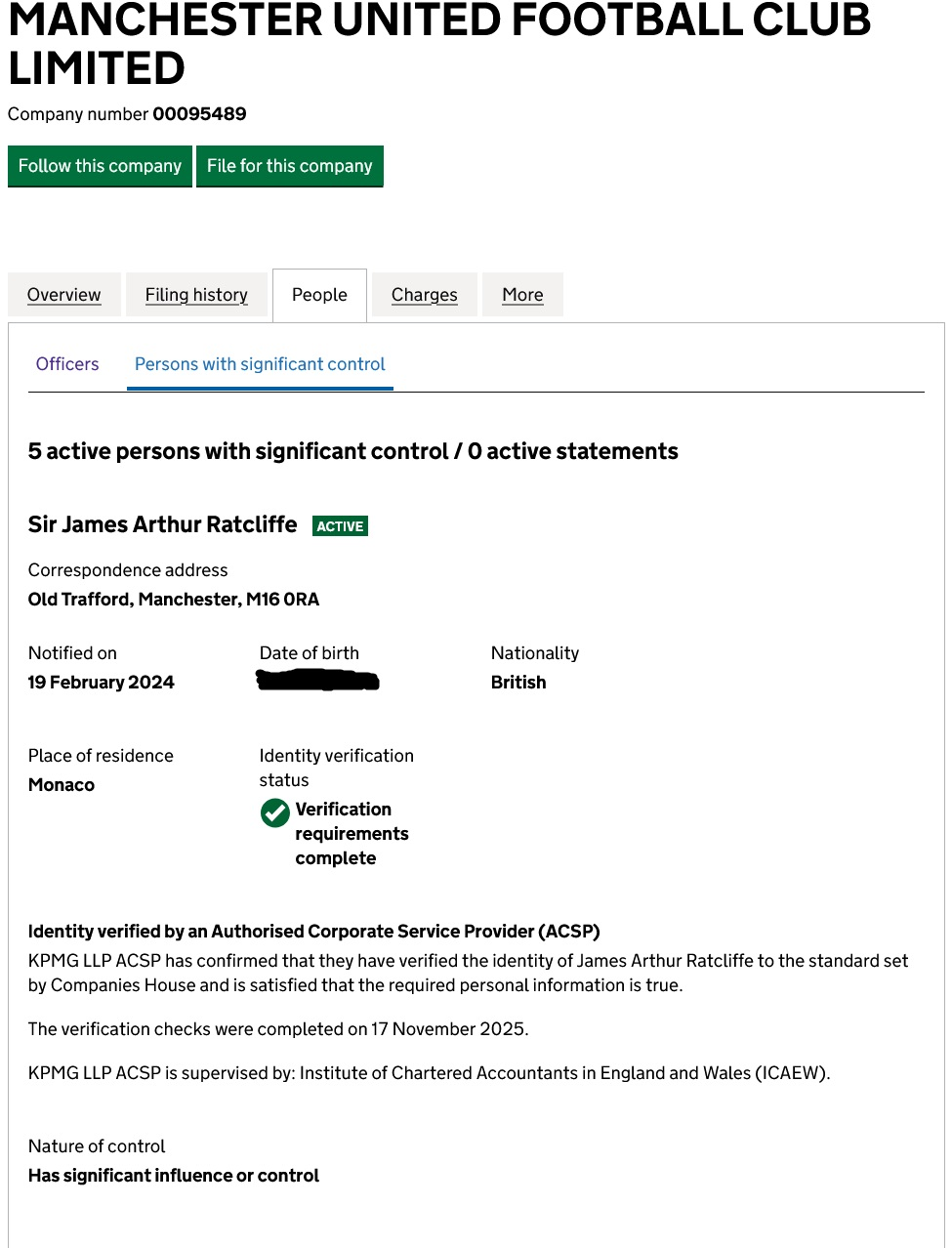
Example: the Companies House record for Manchester United Football Club Limited. The company has five persons with significant control; one is shown here. The date of birth has been blacked out.
Where a PSC is itself a company, we follow the chain. We open that company's record and repeat the process until we reach a natural person, or an entity registered outside the UK.
5.2 Register of Overseas Entities
Overseas entities that hold land in the UK appear in the same Companies House search. Their registration numbers begin with OE. The record shows the registrable beneficial owners in a similar format to a PSC entry.
6. Searching the Estonian register
- Open the e-Business Register at ariregister.rik.ee and select ENG to switch to English.
- Search by company name, registry code or VAT number.
- Open the company record. The shareholders and the beneficial owners are shown in separate sections. A shareholder is not necessarily a beneficial owner.
- Review the beneficial owners section. It shows the name, personal identification code or date of birth, country of residence, the manner in which control is exercised and the date from which it applies.
- Select Show history to view earlier beneficial owners.
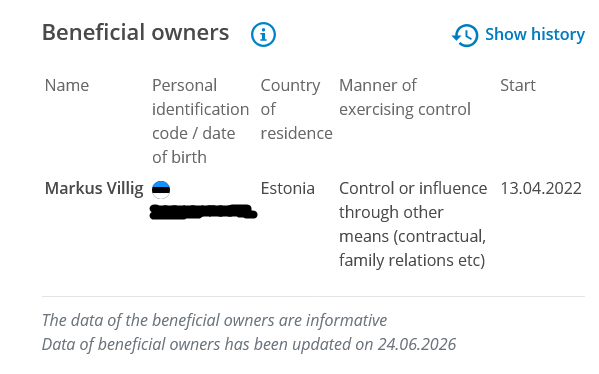
Example: the e-Business Register record for Bolt Technology OÜ. The personal identification code has been blacked out.
This record shows that control is not limited to shareholding. The beneficial owner is recorded as exercising control through other means, which the register describes as contractual arrangements, family relations or similar. The register also states that beneficial ownership data is informative. It is a declaration, and it is treated as such.
7. Searching the Polish register
- Open the Central Register of Beneficial Owners (CRBR) at crbr.podatki.gov.pl. The register has no English version. Browser translation is sufficient for searching.
- Search by company name, NIP (tax identification number) or KRS (National Court Register) number.
- Review the beneficial owners listed. Where the record leads to other companies, we follow the chain as we do for UK PSCs.
Companies listed on a regulated market are not required to register their beneficial owners in the CRBR. The register shows the PESEL, Poland's national identification number, which must not be reproduced in any report or publication.
8. The Latvian register
The Register of Enterprises at info.ur.gov.lv provides company level data without a login. Data on natural persons, including beneficial owners, requires authentication with a Latvian eID, a qualifying e-signature or EU eIDAS credentials. Investigators without such credentials cannot view beneficial owners through the portal.
The Register of Enterprises also publishes register data as open data on data.gov.lv, under a CC0 licence and updated daily. These datasets are reported to include beneficial ownership information. Axeten has not yet assessed them.
9. Requesting access on the basis of a legitimate interest
Where a register is closed to the public, access depends on a request that demonstrates a legitimate interest. Each register sets its own procedure. A request should be expected to set out who is making it and on whose behalf, the entity concerned, and the purpose of the request, including how that purpose connects to the prevention or combating of money laundering, its predicate offences or terrorist financing.
Under the Sixth Anti-Money Laundering Directive, journalists, civil society organisations and academics whose work is connected to these purposes are presumed to have a legitimate interest. Private sector investigators must demonstrate theirs on the facts.
A request is also a record of our own processing. The purpose stated to the register must be consistent with our own documentation for the investigation, including the Legitimate Interests Assessment. We retain each request and each response on the case file.
The European e-Justice Portal lists the national registers and links to each, and is the starting point for identifying the correct procedure.
10. Verification
A beneficial ownership entry is a declaration made by or on behalf of the company. Declarations may be inaccurate or false, and reliance on a single entry carries a risk.
Before identity verification was introduced, Companies House did not verify the identity of the individuals on its register. Entries made before verification are treated with caution. The verification status shown on each UK entry, including the identity of any ACSP that carried out the checks, should be recorded as part of the evidence.
Before we rely on an entry, we:
- compare it with the company's filings and filing history
- check the same individuals and entities on other registers
- check it against independent sources such as OpenCorporates, Open Ownership and OpenSanctions
- search for variant spellings of names, and confirm identity on more than a name alone
11. Resources
11.1 Registers
- United Kingdom, Companies House (PSC register and Register of Overseas Entities): find-and-update.company-information.service.gov.uk
- Estonia, e-Business Register: ariregister.rik.ee
- Poland, Central Register of Beneficial Owners (CRBR): crbr.podatki.gov.pl
- Latvia, Register of Enterprises: info.ur.gov.lv
- Latvia, Register of Enterprises open data: data.gov.lv
- EU national registers, European e-Justice Portal: e-justice.europa.eu
11.2 Independent sources for verification
- OpenCorporates: opencorporates.com
- Open Ownership: openownership.org
- OpenSanctions: opensanctions.org
11.3 Access by country
- Max Intel, European public records by country: maxintel.org
- Kyckr, EU beneficial ownership registers and access: kyckr.com
Legal notice
This guide is provided for information. It is not legal advice, and Axeten is not a law firm. Where access to a register depends on a legal test, legal advice should be taken before a request is made or the information is relied upon.
Requesting access on the basis of a legitimate interest is covered in Module 1 of our 10 Module OSINT Practitioner Training.